
Table of Contents
- 1. Introduction
- 2. Section 1: What is the National Medical Commission (NMC)?
- 3. Section 2: Latest NMC Guidelines for NEET UG Aspirants
- 4. Section 3: NMC Guidelines for the MBBS Admission Process & Counselling
- 5. Section 4: The 50% Fee Regulation Rule
- 6. Section 5: Graduate Medical Education Regulations (GMER) and the MBBS Curriculum
- 7. Section 6: Next Examination (NExT) - The Game Changer
- 8. Section 7: NMC Guidelines for Foreign Medical Graduates (FMGE)
- 9. Section 8: Internships and Rural Service Under NMC Guidelines
- 10. Section 9: Impact of NMC Guidelines on Medical Colleges in India
- 11. Section 10: How MyMBBSAdmission.com Helps You Navigate NMC Guidelines
- 12. Conclusion
- 13. FAQs
Introduction
Navigating the complex landscape of medical education in India requires staying updated with the ever-evolving rules and regulations. For thousands of NEET aspirants and medical students, understanding the NMC guidelines is not just an option—it is an absolute necessity. The National Medical Commission (NMC), the apex regulatory body for medical education and practice in India, continually updates its policies to ensure that the standards of medical education remain world-class, transparent, and fair.
Whether you are preparing for the upcoming NEET UG examination, planning to pursue your MBBS abroad, or are already enrolled in a medical college, the NMC guidelines dictate your academic and professional journey. At MyMBBSAdmission.com, we understand that keeping track of these extensive notifications can be overwhelming. Therefore, we have compiled a comprehensive, easy-to-understand, and detailed breakdown of the latest NMC guidelines. This definitive guide covers everything from NEET eligibility criteria and the MBBS admission process to the Next Examination (NExT) and Foreign Medical Graduate (FMG) regulations.
Section 1: What is the National Medical Commission (NMC)?
Before diving into the specific regulations, it is vital to understand the authority behind them. The National Medical Commission (NMC) was established to replace the Medical Council of India (MCI). Its primary objective is to improve access to quality and affordable medical education, ensure availability of adequate and high-quality medical professionals in all parts of the country, and promote equitable and universal healthcare.
The NMC is structured into four autonomous boards, each handling a specific domain:
- Under-Graduate Medical Education Board (UGMEB): Deals with the curriculum and guidelines for MBBS admissions.
- Post-Graduate Medical Education Board (PGMEB): Handles specializations and PG medical degrees.
- Medical Assessment and Rating Board (MARB): Assesses and ranks medical colleges.
- Ethics and Medical Registration Board (EMRB): Maintains the national register of doctors and regulates professional conduct.
The NMC guidelines issued by these boards are legally binding and form the framework for how medical colleges operate and how admissions are conducted.
Section 2: Latest NMC Guidelines for NEET UG Aspirants
The National Eligibility cum Entrance Test (NEET) is the sole gateway for admission into undergraduate medical courses in India. The NMC frequently updates the guidelines regarding syllabus, eligibility, and the examination pattern.
1. Revisions in the NEET Syllabus
Recently, the NMC introduced significant changes to the NEET UG syllabus, aligning it more closely with the rationalized NCERT curriculum. The revised NMC guidelines for the NEET syllabus removed several outdated topics from Physics, Chemistry, and Biology while adding certain practical-oriented concepts. Aspirants must strictly adhere to the NMC-approved syllabus rather than older textbook editions to ensure focused preparation.
2. Age Limit for NEET UG
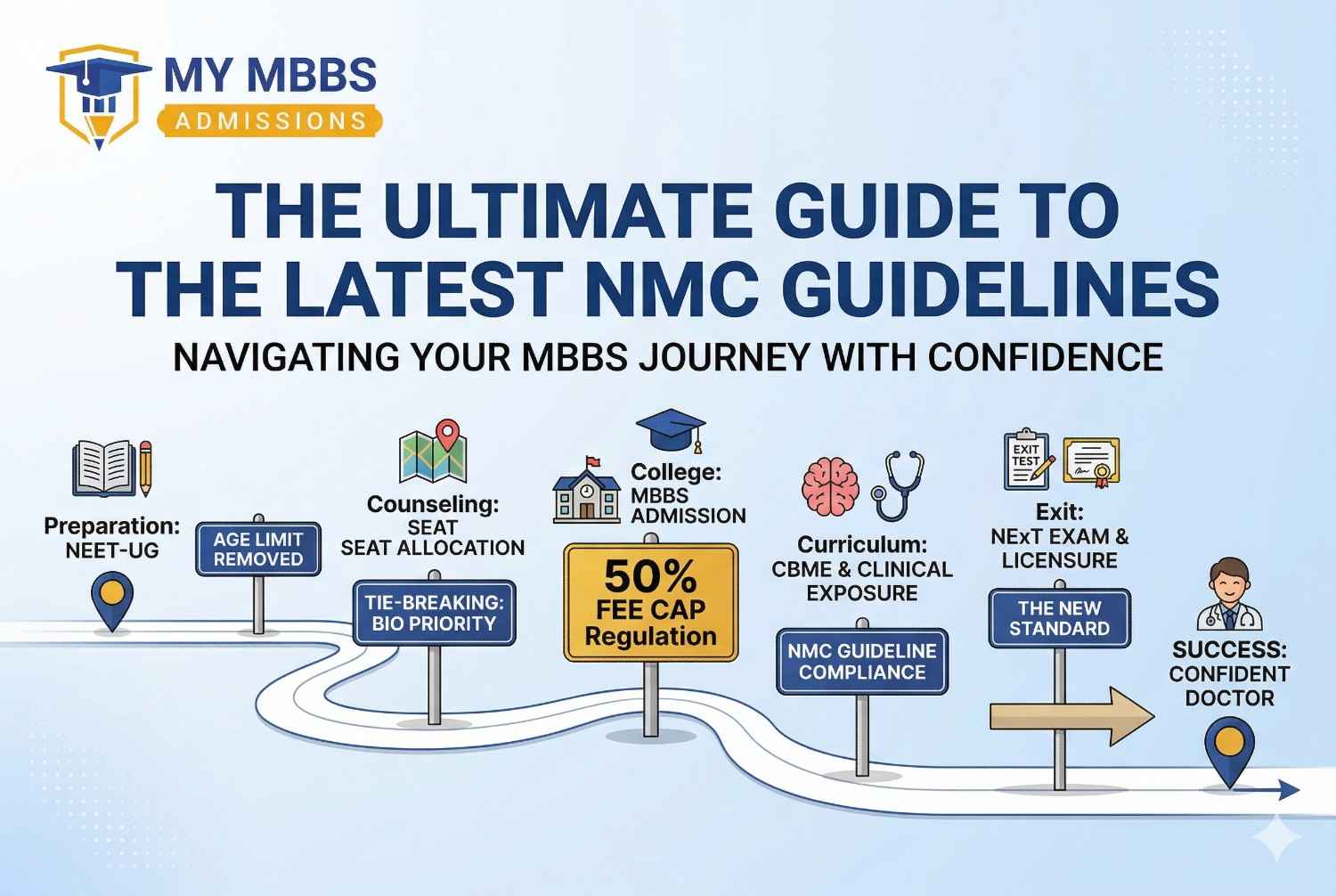
One of the most student-friendly moves under the recent NMC guidelines was the removal of the upper age limit for appearing in the NEET UG exam.
- Minimum Age: Candidates must have completed 17 years of age on or before the 31st of December of the year of their admission.
- Maximum Age: There is no upper age limit. Candidates of any age can appear for NEET and secure an MBBS admission, provided they meet the basic academic criteria.
3. Academic Eligibility
To be eligible for NEET UG as per NMC guidelines:
- Students must have passed 10+2 with Physics, Chemistry, Biology/Biotechnology, and English as core subjects.
- Candidates from open schools and those who studied Biology as an additional subject are now eligible to appear for NEET, expanding the horizon for many aspiring doctors.
Section 3: NMC Guidelines for the MBBS Admission Process & Counselling
Securing a good rank in NEET is just the first step; the counseling process is where the actual admission takes place. The NMC guidelines have streamlined this process to prevent malpractice and ensure merit-based seat allocation.
1. Common Counselling for All Seats
The NMC has proposed a common counseling system for all undergraduate and postgraduate medical seats in India. Previously, the Medical Counselling Committee (MCC) conducted counseling for 15% of All India Quota (AIQ) seats, while state bodies handled the remaining 85%. The shift towards a centralized common counseling process under the NMC guidelines aims to eliminate seat blocking and bring absolute transparency.
2. The Tie-Breaking Criteria
When millions of students appear for NEET, tie scores are inevitable. The NMC guidelines have updated the tie-breaking rules. If two or more students secure the same marks, the tie will be resolved in the following order:
- Higher marks/percentile in Biology (Botany & Zoology).
- Higher marks/percentile in Chemistry.
- Higher marks/percentile in Physics.
- Proportion of incorrect to correct answers across all subjects.
- Previously, age was a tie-breaking factor (older candidates were preferred), but the latest NMC guidelines have scrapped the age criteria for tie-breaking.
3. Ban on Stray Vacancy Round Manipulation
To curb the exorbitant "donations" collected by private medical colleges during the final admission rounds, the NMC guidelines strictly prohibit college-level admissions. All admissions, including the stray vacancy round, must be conducted online through the centralized counseling authority.
Section 4: The 50% Fee Regulation Rule
One of the most debated and revolutionary steps taken by the commission is regarding the fee structure in private medical colleges. According to the NMC guidelines, the fees for 50% of the seats in private medical colleges and deemed universities must be equal to the fee structure of government medical colleges in that particular state.
Impact of the Fee Rule:
- Affordability: This regulation allows meritorious students from middle-class backgrounds to study in private medical colleges without bearing the burden of astronomical tuition fees.
- Merit-Based Allocation: These 50% seats are allotted strictly based on NEET merit during counseling.
- While the implementation of this rule is currently undergoing legal and administrative adjustments across various states, it remains a cornerstone of the NMC’s vision for affordable medical education.
Section 5: Graduate Medical Education Regulations (GMER) and the MBBS Curriculum
Once a student secures MBBS admission, their academic life is governed by the Competency-Based Medical Education (CBME) curriculum laid down by the NMC guidelines.
1. Foundation Course
The MBBS journey now begins with a mandatory Foundation Course. This aims to bridge the gap between school education and the rigorous demands of medical science. It covers communication skills, medical ethics, time management, and language proficiency.
2. Shift to Clinical Exposure
The new NMC guidelines emphasize early clinical exposure. Unlike the traditional curriculum where students were confined to classrooms for the first two years, the CBME curriculum mandates that students interact with patients and observe hospital settings right from their first year. This ensures a more practical, hands-on approach to becoming a doctor.
3. Electives and Skill Modules
Medical students are now required to complete elective postings in areas outside their core subjects, allowing them to explore research, public health, or specific clinical specialties. Furthermore, the NMC guidelines mandate the completion of specific skill modules, including basic and advanced life support, before they can begin their internships.
4. Limit on Attempting University Exams
To maintain high academic standards, the NMC guidelines stipulate a maximum time frame for completing the MBBS degree. A student is permitted a maximum of four attempts to clear the first professional MBBS exams. Furthermore, the entire MBBS course, including the internship, must be completed within nine years from the date of admission.
Section 6: Next Examination (NExT) - The Game Changer
The most transformative change introduced in the NMC guidelines is the introduction of the National Exit Test (NExT). This single examination will replace multiple existing exams, serving a threefold purpose:
- Licentiate Exam: It will serve as the qualifying exam for final-year MBBS students to obtain their license to practice medicine in India.
- PG Entrance: NExT will replace NEET PG. The scores obtained in NExT Step 1 will determine admissions to MS, MD, and other postgraduate courses.
- FMGE Replacement: Foreign medical graduates will no longer take a separate screening test. They will appear for NExT alongside Indian medical graduates to validate their degrees.
Structure of NExT:
According to the NMC guidelines, NExT will be conducted in two steps:
NExT Step 1: A theoretical, multiple-choice question (MCQ) based exam conducted at the end of the final year of MBBS. It will test clinical reasoning and problem-solving skills rather than rote learning.
NExT Step 2: A practical, clinical, and viva-voce exam conducted after the completion of the compulsory rotating medical internship (CRMI). It will be a "pass/fail" exam assessing the practical competence of the young doctor.
While the exact timeline for the nationwide rollout of NExT is being continuously monitored and updated, students must align their preparation with the clinical orientation of the NExT pattern.
Section 7: NMC Guidelines for Foreign Medical Graduates (FMGE)
Studying MBBS abroad is a popular choice for many Indian students. However, the NMC has laid down strict regulations for those planning to pursue medical degrees in countries like Russia, Georgia, Kazakhstan, and the Philippines. The Foreign Medical Graduate Licentiate (FMGL) Regulations under the NMC guidelines outline the following mandatory criteria:
1. Minimum Duration of the Course
The foreign medical degree must have a minimum duration of 54 months of theoretical and practical training.
2. Mandatory Internship Abroad
Students must complete a 12-month compulsory clinical internship in the same institution/country where they completed their medical degree.
3. Medium of Instruction
The entire MBBS course must be taught in the English language. Bilingual courses are strictly not recognized under the latest NMC guidelines.
4. License to Practice in the Host Country
The student must be registered with the professional regulatory body of the country where they studied. In simpler terms, to be eligible to practice in India, the student must first be eligible to practice in the country where they obtained their degree.
5. Compulsory Rotating Medical Internship (CRMI) in India
Upon returning to India and clearing the FMGE (or NExT), foreign medical graduates must undergo an additional 12-month CRMI in an approved Indian medical college to familiarize themselves with the Indian healthcare system and disease patterns.
Important Note: At MyMBBSAdmission.com, we highly recommend that students verify if their chosen university abroad strictly complies with these NMC guidelines before taking admission, as failure to meet even one criterion will render the degree invalid in India.
Section 8: Internships and Rural Service Under NMC Guidelines
The compulsory rotating medical internship (CRMI) is a critical phase where theoretical knowledge is applied in real-world healthcare.
1. Standardized Stipend
The NMC guidelines clearly state that all interns, whether studying in government or private medical colleges, must be paid a stipend at par with the state government norms. This addresses the long-standing grievance of private college interns who were often denied fair compensation.
2. Rural Postings
To strengthen the rural healthcare infrastructure, the NMC guidelines mandate that a specific portion of the internship must be spent in rural health centers (PHCs and CHCs). This ensures that young doctors are well-versed in handling primary healthcare at the grassroots level.
3. Restrictions on Transfer of Internship
Interns must complete their training in the same institution where they pursued their MBBS. Transfers for internships to other colleges or states are generally not permitted under the NMC guidelines unless there are extreme, specific circumstances authorized by the commission.
Section 9: Impact of NMC Guidelines on Medical Colleges in India
The NMC does not just regulate students; it maintains a tight grip on medical colleges to ensure quality infrastructure and teaching standards. The Medical Assessment and Rating Board (MARB) under the NMC is responsible for evaluating colleges.
1. Minimum Standard Requirements (MSR)
The NMC guidelines specify detailed MSRs that every medical college must fulfill. This includes the required number of hospital beds, the patient-to-student ratio, laboratory facilities, library resources, and the strength of the teaching faculty.
2. Biometric Attendance for Faculty
To combat the issue of "ghost faculty" (teachers who exist only on paper), the NMC has mandated Aadhaar-enabled biometric attendance systems (AEBAS) for all teaching staff. Medical colleges failing to meet the minimum faculty attendance criteria face heavy penalties, including the reduction of seat intake or loss of recognition.
3. Penalty for Withholding Original Documents
Many private medical colleges previously engaged in the unfair practice of withholding students' original educational certificates to force them to pay total course fees if they wished to leave the course midway. The NMC guidelines strictly prohibit institutions from holding original documents, ensuring that students' rights are protected.
Section 10: How MyMBBSAdmission.com Helps You Navigate NMC Guidelines
With rules updating frequently, keeping track of NMC notifications can distract a student from their primary goal: studying. This is where MyMBBSAdmission.com steps in as your trusted mentor and guide.
- Latest Updates: We provide real-time updates and simplified breakdowns of every new notification released by the National Medical Commission.
- Counseling Assistance: Our expert counselors understand the intricate details of the NMC guidelines for the admission process, helping you make informed choices during centralized counseling.
- Study Abroad Verification: If you are planning an MBBS abroad, our team rigorously verifies foreign universities against the FMGL regulations to ensure your degree will be 100% valid in India.
- NEET Preparation Strategy: We align our content, mock tests, and strategy sessions with the latest syllabus and exam patterns mandated by the NMC.
Conclusion
The NMC guidelines represent a paradigm shift in Indian medical education. From modernizing the MBBS curriculum to making admissions transparent and standardizing the licensure process through NExT, the National Medical Commission is paving the way for a more competent and globally competitive generation of doctors.
Whether you are a NEET aspirant analyzing the syllabus, a parent calculating the fee structure, or an FMG planning your return to India, understanding these rules is the bedrock of a smooth educational journey. Remember, ignorance of these guidelines is not an excuse. Stay informed, stay focused on your preparation, and let the rules guide you toward a successful medical career
For the most accurate, up-to-date information and expert guidance on your medical journey, keep visiting MyMBBSAdmission.com. We are dedicated to turning your dream of wearing the white coat into a reality.
FAQS
The candidate must be at least 17 years old by December 31 of the admission year. There is no upper age limit. The student must have passed 10+2 with Physics, Chemistry, Biology/Biotechnology, and English. Students from open schools are also eligible.
Yes, all government, private, and deemed medical universities operating in India must strictly adhere to the NMC guidelines.
As per the FMGL regulations, the course must be at least 54 months long, followed by a 12-month internship in the host country. It must be taught entirely in English, and the student must be eligible for registration to practice in the country where the degree was awarded.
Yes, the National Medical Commission (NMC) officially replaced the Medical Council of India (MCI) on September 25, 2020, to regulate medical education and practice in India.
The National Exit Test (NExT) is a proposed unified examination that will act as a licentiate exam for MBBS graduates, a replacement for NEET PG for postgraduate admissions, and a screening test for Foreign Medical Graduates (FMGE).
Yes, under a highly significant NMC guideline, 50% of seats in private medical colleges and deemed universities must have fee structures equivalent to government medical colleges in that respective state/union territory.
According to the latest NMC guidelines for the CBME curriculum, a medical student is permitted a maximum of four attempts to clear the first professional MBBS university examinations.