
Table of Contents
- 1. Role of the AMC, USMLE and PLAB Exams for MBBS Students
- 2. Introduction to AMC, USMLE and PLAB
- 3. What is the Australian Medical Council (AMC)?
- 4. What is the United States Medical Licensing Examination (USMLE)?
- 5. What is the Professional and Linguistic Assessments Board (PLAB)?
- 6. Comparison Between AMC, USMLE and PLAB
- 7. Eligibility Criteria for AMC, USMLE and PLAB
- 8. Exam Pattern and Syllabus Comparison
- 9. Best Countries for MBBS Graduates
- 10. Conclusion
- 11. FAQs
Role of the AMC, USMLE and PLAB Exams for MBBS Students
For MBBS graduates who aspire to build a successful medical career abroad, clearing international licensing exams is the most crucial first step. Among the most recognized pathways are the Australian Medical Council (AMC), the United States Medical Licensing Examination (USMLE), and the Professional and Linguistic Assessments Board (PLAB). These exams act as gateways to practicing medicine in countries like Australia, the United States, and the United Kingdom. Along with licensing, they also provide access to advanced training, better salaries, and global exposure. This detailed guide will help you understand every important aspect of AMC, USMLE and PLAB and how to choose the right path.
Introduction to AMC, USMLE and PLAB
The AMC, USMLE and PLAB exams are designed to ensure that international medical graduates meet the professional and clinical standards required in foreign healthcare systems. These exams are not just theoretical assessments; they evaluate real-world clinical competence.
- AMC enables doctors to practice in Australia
- USMLE is required for medical licensure in the USA
- PLAB allows international doctors to work in the UK
All three exams assess:
- Clinical knowledge and application
- Patient management skills
- Communication with patients
- Clinical decision-making ability
Selecting between AMC, USMLE and PLAB depends on several important factors such as your career goals, financial capacity, preferred country, and academic preparation.
What is the Australian Medical Council (AMC)?
Australia has become a preferred destination for many MBBS graduates due to its high-quality healthcare system and balanced lifestyle. The Australian Medical Council exam evaluates whether international graduates are ready to practice medicine in Australia. The exam consists of two main stages: MCQ and clinical examination.
AMC MCQ Exam
The AMC MCQ is a computer-based test consisting of 150 multiple-choice questions. These questions are designed to assess how effectively candidates can apply their medical knowledge in clinical scenarios rather than just recalling theoretical concepts.
The exam is conducted at authorized test centers using a digital interface, ensuring uniformity and faster result processing. Candidates must be comfortable using computers and navigating exam software.
The 150 questions are case-based and require analytical thinking. Each question presents a clinical situation where candidates must choose the most appropriate diagnosis or treatment. Although there is only one correct answer, multiple distractors are included to test decision-making accuracy.
The AMC MCQ exam mainly focuses on clinical subjects such as:
- Internal medicine
- Surgery
- Pediatrics
- Obstetrics and gynecology
- Psychiatry
- General practice
This structure ensures that candidates are prepared for real-life medical situations in Australian hospitals.
AMC Clinical Exam
After clearing the MCQ stage, candidates must appear for the AMC clinical exam. This stage is designed to evaluate practical skills through the Objective Structured Clinical Examination (OSCE).
The OSCE is a hands-on assessment where candidates rotate through different stations. Each station tests a specific skill, such as patient interaction, diagnosis, or treatment planning.
A key feature of this exam is the inclusion of real-life patient scenarios. Candidates may be required to take patient history, explain diagnoses, or respond to emergency situations. This ensures that they are prepared for real clinical environments.
The AMC clinical exam also focuses heavily on communication and professionalism. Doctors must demonstrate empathy, clarity in explanation, and the ability to build trust with patients. Clinical skills such as physical examination, reasoning, and treatment planning are equally important.
What is the United States Medical Licensing Examination (USMLE)?
Among AMC, USMLE and PLAB, the USMLE is considered the most rigorous and competitive pathway. It is designed to assess a candidate’s ability to apply medical knowledge in a highly advanced healthcare system like that of the United States.
Steps of USMLE
The USMLE consists of three steps:
Step 1
This step focuses on basic sciences such as anatomy, physiology, and biochemistry. It builds the foundation for understanding medical concepts.
Step 2
This stage evaluates clinical knowledge and the ability to diagnose and manage patients effectively.
Step 3
This is the final licensing step, usually taken during or after residency. It confirms whether a candidate is ready to practice independently.
Residency Requirement
A major difference between AMC, USMLE and PLAB is that USMLE requires candidates to secure a residency position in the United States.
After clearing the exams, candidates must apply through the National Resident Matching Program (NRMP). This system matches applicants with hospitals based on merit and preference. Securing a residency is essential for obtaining a medical license in the USA.
Although the USMLE pathway is time-consuming and expensive, it offers the highest career growth, advanced specialization, and top-tier salaries.
What is the Professional and Linguistic Assessments Board (PLAB)?
The PLAB exam is conducted by the General Medical Council (GMC) in the UK. It is designed to ensure that international doctors have the necessary skills to work safely in the National Health Service (NHS).
PLAB Structure
PLAB consists of two parts:
PLAB 1
This is a multiple-choice exam that tests clinical knowledge and problem-solving ability. Each question presents a medical scenario, and candidates must choose the best possible answer.
The exam covers major medical subjects such as medicine, surgery, pediatrics, obstetrics, gynecology, and psychiatry. It is designed according to UK healthcare standards.
PLAB 2
This is a clinical exam conducted using the OSCE format. Candidates are tested through practical scenarios where they interact with patients, perform examinations, and make clinical decisions.
This stage focuses on communication, professionalism, and real-world medical skills.
Among AMC, USMLE and PLAB, PLAB is often considered more practical and accessible, especially for candidates looking for a faster route to work abroad.
Comparison Between AMC, USMLE and PLAB
Understanding the differences between AMC, USMLE and PLAB is essential before choosing the right pathway. Each exam varies in terms of difficulty, cost, duration, and career outcomes.
- Country: AMC (Australia), USMLE (USA), PLAB (UK)
- Difficulty Level: AMC (Moderate), USMLE (Very High), PLAB (Moderate)
- Cost: AMC (High), USMLE (Very High), PLAB (Low)
- Duration: AMC (1–2 years), USMLE (3–5 years), PLAB (1–2 years)
- Residency Requirement: AMC (Not always required), USMLE (Mandatory), PLAB (Not required)
- Salary Potential: AMC (High), USMLE (Very High), PLAB (Moderate)
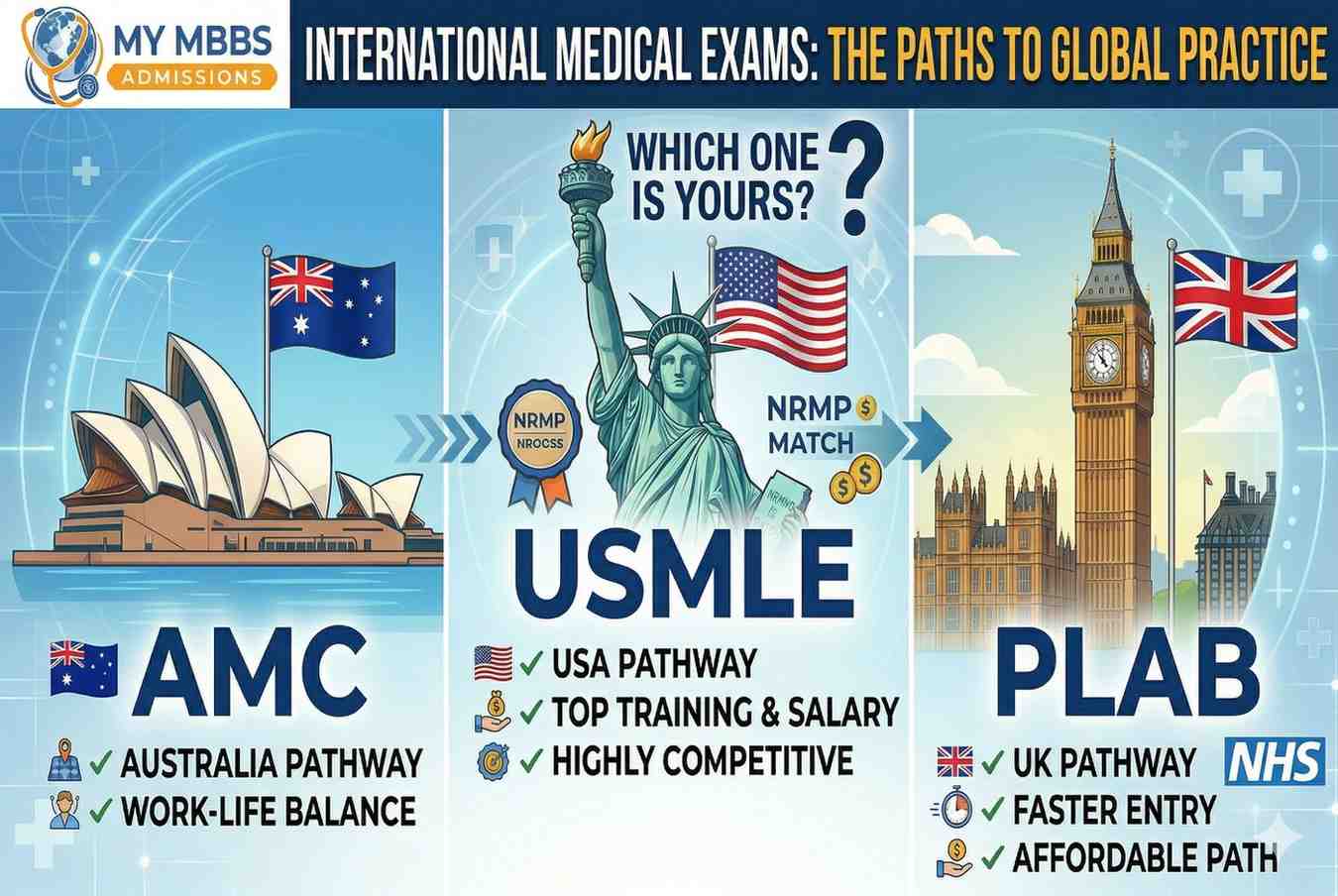
This comparison clearly shows that AMC, USMLE and PLAB are designed for different types of candidates. While USMLE offers the highest rewards, PLAB provides a quicker and more affordable route, and AMC ensures a balanced professional life.
Eligibility Criteria for AMC, USMLE and PLAB
Before applying for AMC, USMLE and PLAB, candidates must meet certain eligibility requirements. These criteria ensure that only qualified medical graduates enter foreign healthcare systems.
Academic Requirements
Candidates must hold an MBBS degree from a recognized medical university. The institution should be listed in the World Directory of Medical Schools, which confirms that the degree meets global standards. Without this recognition, candidates may not be eligible to appear for AMC, USMLE and PLAB exams.
Internship Requirement
A one-year compulsory internship is an important requirement for most pathways. For AMC and PLAB, internship completion is generally mandatory as it demonstrates practical clinical exposure.
In contrast, for USMLE, internship is not compulsory at the exam stage, but it is strongly recommended. Clinical experience improves your chances of securing a residency in the United States.
English Language Proficiency
Strong communication skills are essential for medical practice abroad. For AMC and PLAB, candidates must clear English language tests such as IELTS or OET.
For USMLE, there is no formal English language exam requirement. However, communication skills are assessed indirectly during clinical practice and residency.
Thus, language proficiency remains a key factor when preparing for AMC, USMLE and PLAB.
Exam Pattern and Syllabus Comparison
A clear understanding of the exam structure helps candidates prepare effectively for AMC, USMLE and PLAB.
AMC: Clinical-Based and Practical Approach
The AMC exam focuses heavily on clinical scenarios and real-life medical practice. Questions are designed to test decision-making skills rather than theoretical memorization.
Candidates are expected to analyze patient cases, make diagnoses, and suggest treatment plans. This ensures readiness for real hospital environments in Australia.
USMLE: Conceptual Depth and Integration
The USMLE is known for its deep focus on medical concepts. It tests subjects like physiology, pathology, pharmacology, and biochemistry in detail.
Unlike other exams, USMLE integrates theoretical knowledge with clinical application. Many questions combine basic science concepts with real-life cases, requiring strong analytical skills.
This makes USMLE the most demanding among AMC, USMLE and PLAB.
PLAB: Practical and Scenario-Based
PLAB is designed to evaluate whether a candidate can work as a junior doctor in the UK. The exam focuses on practical, scenario-based questions aligned with NHS guidelines.
Candidates must choose appropriate actions in real-life situations, emphasizing patient safety, ethics, and communication.
Among AMC, USMLE and PLAB, PLAB is considered the most practical and straightforward in terms of exam pattern.
Best Countries for MBBS Graduates
Choosing the right country is just as important as selecting between AMC, USMLE and PLAB. Each destination offers unique advantages.
Australia
Australia is a top choice for international medical graduates due to its excellent healthcare system and quality of life. Doctors in Australia benefit from controlled working hours, modern infrastructure, and a high standard of living.
There is also a strong demand for doctors, especially in rural and regional areas. This increases job opportunities for candidates who clear AMC exams.
United States
The USA is considered the best destination for advanced medical training and specialization. Through USMLE, candidates gain access to world-class residency programs and cutting-edge medical technology.
The country offers numerous specialization options and the highest salary potential among all three pathways. However, the process is highly competitive and requires significant time and financial investment.
United Kingdom
The UK is a popular choice for those seeking a faster and more cost-effective route. After clearing PLAB and registering with the General Medical Council, candidates can directly apply for jobs in the NHS.
The UK also offers structured training programs, allowing doctors to progress step by step while gaining experience. Additionally, the multicultural work environment provides exposure to diverse medical cases.
Conclusion
Choosing between AMC, USMLE and PLAB is one of the most important decisions for MBBS graduates who want to work abroad. Each pathway offers unique benefits and challenges.
- Choose USMLE if your goal is high salary and specialization
- Choose AMC for a balanced lifestyle and stable career
- Choose PLAB for a faster and affordable route to the UK
Before making a decision, carefully evaluate your financial resources, career aspirations, and academic strengths. A well-informed choice will help you build a successful international medical career.
FAQS
The ideal choice among AMC, USMLE and PLAB depends on your career goals. USMLE is best for high-paying careers and specialization. PLAB is suitable for candidates looking for affordability and faster entry. AMC is ideal for those seeking work-life balance.
Among AMC, USMLE and PLAB, PLAB is generally considered the easiest due to its practical approach and higher pass rates compared to the other two exams.
- USMLE: ₹15–25 lakhs
- AMC: ₹5–8 lakhs
- PLAB: ₹3–5 lakhs
USMLE is the most expensive, while PLAB is the most budget-friendly option.
IELTS or OET is mandatory for AMC and PLAB pathways. For USMLE, there is no formal English test requirement, but strong communication skills are essential for clinical practice.